
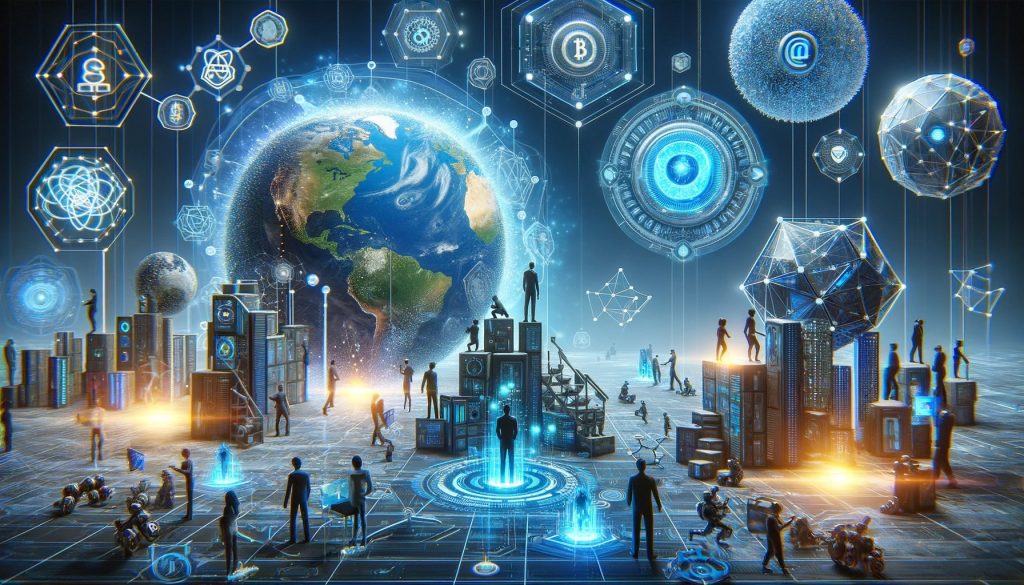
Imagine a vast, conected network of virtual spaces where users engage in 3D environments—this is what we call the metaverse. This concept, once only a speculative vision, is rapidly becoming a real reality, supported by a suite of advanced technologies. Each technology plays a unique role in creating an environment that is not just immersive and responsive, but also secure. This article explores these fundamntal technologies, exploring their roles and the synergy that is essential for the architecture of the metaverse.
Core Technologies Behind the Metaverse
Virtual and Augmented Reality (VR & AR)
At the hart of the metaverse are Virtual Reality (VR) and Augmented Reality (AR). These technologies create deeply immersive experiences that let users go beyond the limits of physical reality:
- VR Envelops Users: VR creates fully immersive enviroments where users can interact as if they were really there.
- AR Enhances Real Worlds: AR ads digital information onto the real world, enhancing everyday experiences.
Examples in Use:
- VR Conferencing: Platforms like ‘Spatial’ let users work together in a virtual space that looks like a physical office, showing the potential for remote work within the metaverse.
- AR Navigation: Apps such as ‘Pokemon Go’ mix AR with real-world geography, showing how future metaverse applications might blend into our daily routines smothly.
Artificial Intelligence (AI)
AI acts as the unsung hero of the metaverse, enhancing user interactions through machine learning and natural language processing, enabling avatars to understand and react to human inputs with increasing cleverness.
Enhancing Interaction:
- Avatar Customisation: AI algorithms can create very realistic avatars in real-time, personalised to reflect individual user details.
- Environmental Responsiveness: AI makes it possible to create dynamic environments that respond intelligently to user actions, making the virtual world feel more alive.
Supporting Technologies for the Metaverse
Internet of Things (IoT)
IoT technology integrates real-world data into the metaverse, enabling environments that reflect real-time changes and interactions happening globally:
- Smart Homes in the Metaverse: Users can adjust their home’s lighting or temperature through a virtual control panel that reflects their physical home’s IoT system.
- Industrial IoT: Factories might use digital twins within the metaverse to simulate and optimise operations before making physical changes.
3D Modeling and Spatial Computing
The creation of detailed, immersive virtual worlds relies on sophisticated 3D modeling techniques and spatial computing:
- Architectural Visualization: Real estate companies can make detailed 3D models of properties, letting potential buyers explore buildings virtually.
- Product Design: Companies can prototype new products in 3D, refining designs in a cost-effective virtual space before making physical versions.
Emerging Technologies and Future Trends
Edge Computing
Edge computing improves the metaverse by processing data closer to the user, reducing latency and improving the overall user experience:
- Local Data Handling: Processing data on local nodes rather than central servers ensures almost instant interactions, crucial for maintaining the realism of virtual environments.
5G Connectivity
The arrival of 5G technology revolutionises the metaverse by providing the bandwidth needed for high-density data transfers at unprecedented speeds:
- Enhanced Mobile Access: With 5G, users can access complex metaverse environments from their mobile devices without experiencing lag, making virtual worlds more accessible to everyone, everywhere.
Conclusion
As we move into a future intertwined with virtual realities, the role of key technologies—from VR and AI to IoT and edge computing—becomes increasingly vital. These technologies not only underpin the infrastructure of the metaverse but also ensure it is expansive and engaging. Their convergence will dictate the speed at which the metaverse evolves, heralding a new era of digital interaction that could fundamentally change our social and professional landscapes.
FAQs
The metaverse is a big network of interconnected 3D virtual environments where users can interact, offering a new dimension to digital connectivity.
VR is very important because it provides the immersive experience that is central to the metaverse, allowing users to fully engage with the virtual world.
Blockchain makes sure that the metaverse operates as a secure, decentralized environment, very important for user trust and system integrity.
AI improves the interactivity of the metaverse by enabling realistic avatars and smart environments, which are essential for a smooth user experience.
Edge computing, by reducing latency, significantly impacts the metaverse, making sure smooth and responsive virtual experiences.